
IFRS valuation services
IFRS 9 expected credit loss on trade receivables
Provision matrices for IFRS 9 and Ind AS 109, built from your ageing data and ready for audit.
Receivables we cover for IFRS 9 expected credit loss
- Trade receivablesLifetime ECL under the simplified approach.
- Contract assets and lease receivablesContract assets follow the same rule; for lease receivables the simplified approach is an accounting policy choice.
- Intercompany and related-party balancesOften left out, but within scope in each entity's own accounts.
- Slow-paying receivablesLosses projected and discounted where they emerge over a longer period.
- Loans and other financial assetsThe general, three-stage approach where the simplified one is not available.
What you get
- A documented credit loss policy: definition of default, ageing buckets, segmentation
- A provision matrix of loss rates by ageing bucket and segment
- The ECL allowance and its movement over the year
- IFRS 7 / Ind AS 107 disclosure tables
- A report setting out data, method and judgements for your auditors
- If you want it, the model implemented for you, so that you can run the assessment yourselves
- Support through the audit, including auditors' queries
How an ECL valuation works with us
- Request a quoteShare your receivables profile and entities; we quote on that scope.
- Send us your dataE-mail us your aged balances and write-off history, or use a secure channel we agree with you.
- Build the provision matrixHistorical loss rates, adjusted for current conditions and a forward-looking overlay agreed with you.
- Receive your reportECL, disclosures and the working behind them, with audit support.
Questions clients ask about IFRS 9 ECL
What is expected credit loss on trade receivables, and do we need a complex model?
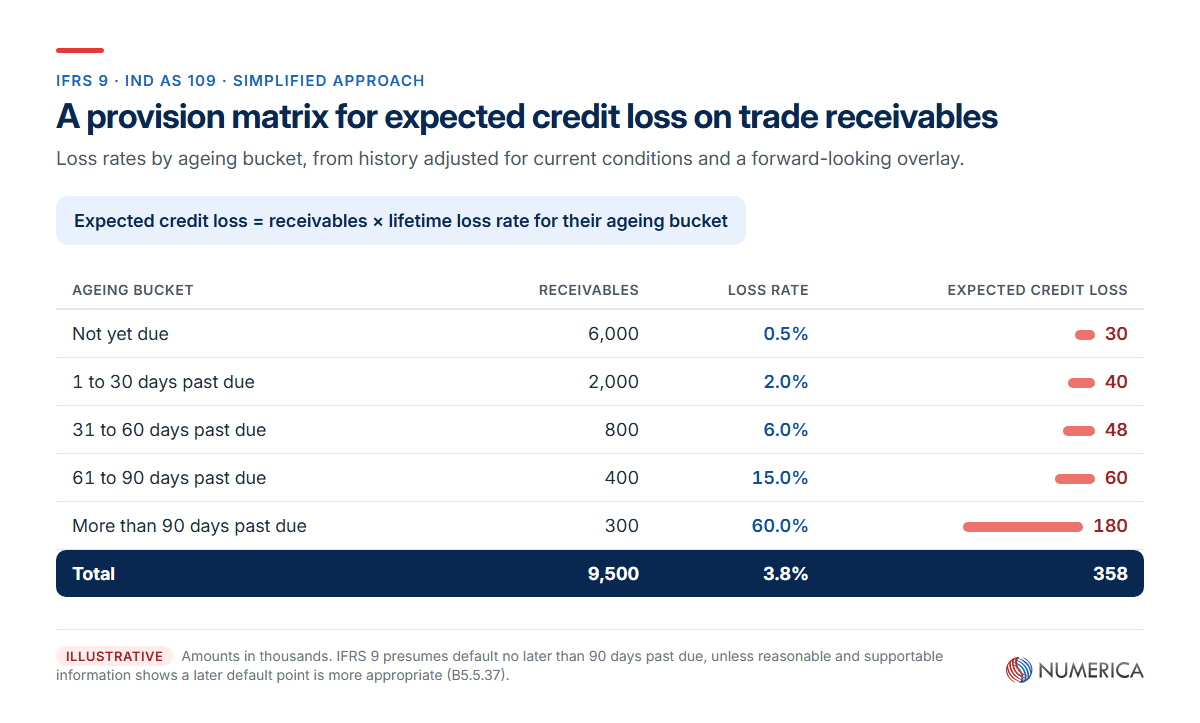
Expected credit loss (ECL) is the loss allowance IFRS 9 and Ind AS 109 require for credit losses on trade receivables, from the day they are recognised, not when invoices fall overdue. Trade receivables without a significant financing component, which is most of them, must use the simplified approach: lifetime losses, with no tracking of credit risk stages, so no complex model. A provision matrix is the usual method, as our guide to calculating ECL on trade receivables shows.
Why is IFRS 9 ECL hard in practice?
Often because of the data. Historical records can be incomplete or badly structured, and ageing reports inconsistent, so expected credit loss rates come out wrong. Teams also overlook IFRS 7 and Ind AS 107 disclosures, or apply one flat rate to every ageing bucket. Auditors then challenge the method and assumptions. Our post sets out the common pitfalls in ECL on trade receivables.
How should credit notes and partial payments be treated?
Credit notes are usually not credit losses. Returns, disputes and price concessions reduce revenue under IFRS 15 or Ind AS 115, which comes first; expected credit loss then covers what customers fail to pay. Left in your data, they overstate provision matrix loss rates. Partial payments need matching to the right invoices, or balances sit in the wrong ageing bucket. See how to calculate historical loss rates.
Who is this service for, and can we run the assessment ourselves?
It suits SMEs and mid-market companies, groups moving to IFRS or Ind AS, and finance teams short of modelling experience, facing a year-end audit or unsure of their current ECL figures. We produce your ECL report under IFRS 9, and can also implement the model for you so that you can run the assessment yourselves. For other standards, see our IFRS valuation services.
Our receivables are short-term. Do we need to discount?
Often the effect is immaterial. IFRS 9 measures expected losses at present value, discounted at the effective interest rate, and for trade receivables that rate depends on whether there is a significant financing component under IFRS 15. Where some balances default slowly, the timing of losses can matter, so we project and discount them.
What definition of default should we use?
One you document and apply consistently. IFRS 9 presumes default no later than 90 days past due, unless you have reasonable and supportable information that a later point fits your customers better. Without a clear definition, loss rates move from year to year for the wrong reasons and auditors will challenge them.
Is our historical loss experience enough?
No. IFRS 9 requires the measurement to reflect current conditions and reasonable, supportable forecasts, not history alone. We adjust historical loss rates for current conditions and add a forward-looking overlay sized to what is material for your book.
Closing your accounts?
Share your receivables profile, and we will quote on that scope.