
Employee benefits · India
Actuarial valuation of gratuity, leave and pensions in India
An actuarial valuation puts a present value on the benefits you owe staff, under Ind AS 19, AS 15, IAS 19 and US GAAP.
Gratuity, leave and pension plans we value
- GratuityStatutory gratuity under the Code on Social Security, 2020, and enhanced company schemes, funded or unfunded.
- Leave encashmentAccumulated leave that can be encashed or availed, valued as compensated absences.
- PensionsDefined benefit pension schemes, open or closed to new members.
- Post-retirement medicalMedical cover that continues after retirement.
- Exempt provident fundThe interest-rate guarantee on an exempt provident fund trust.
- Long-service awardsAnd other long-term benefits paid after years of service.
- Deferred income plansDeferred bonus arrangements, payable twelve months or more after the end of the year in which they are earned.
- Employee loansInterest-free and concessional loans to staff, valued under Ind AS 109 and Ind AS 19.
- Voluntary retirementPayments offered to employees who agree to leave before retirement, valued as termination benefits.
What you get from an Ind AS 19 or AS 15 valuation
- An actuarial valuation report (sometimes called an actuarial certificate) with the disclosures the standard requires: the reconciliation of the defined benefit obligation under both, and under Ind AS 19 also the sensitivity analysis and maturity profile
- Entries for profit or loss and, under Ind AS 19, other comprehensive income
- An explanation of the movement in the liability over the year, with actuarial gains and losses by source
- Projected expense for the coming year, for budgets and interim booking
- Support with assumptions, including a discount rate drawn from our published Indian rupee discount curves
- Answers to your auditors' questions on the report
How an actuarial valuation works with us
- Request a quoteTell us your plans and headcount and get an instant quote*.
- Send us your dataE-mail your employee data, or upload it to Numex, our secure client portal.
- Agree the assumptionsWe propose the discount rate, salary escalation and attrition; you confirm them.
- Receive your reportReports in as little as 2 hours, then we answer your auditors' queries.
*In most cases.
Questions clients ask about gratuity, leave and pension valuation
Gratuity
Is actuarial valuation compulsory for gratuity?
For most companies, yes, although the requirement comes from the accounting standards, not gratuity law. A company under Ind AS 19 or AS 15 measures its gratuity liability actuarially for its year-end accounts, and that includes small and medium-sized companies. Gratuity law generally applies from 10 employees, but a company paying gratuity with fewer still has a liability to measure. Non-company entities classed as MSMEs may use another rational method. See our guide to the applicability of actuarial valuation on gratuity.
Do we need an actuarial valuation if LIC or another insurer runs our gratuity fund?
Almost always, yes. As our FAQs on funded gratuity schemes explain, funding does not remove the need for a valuation. Under most group gratuity policies, benefits come out of your own fund and any shortfall is yours, so Ind AS 19 and AS 15 still treat the plan as defined benefit. The insurer's fund statement is no substitute: the valuation measures the obligation, and the fund is set against it.
Do the labour codes change our gratuity valuation?
For many employers, yes. The Code on Social Security, 2020, in force since 21 November 2025, bases gratuity on wages as defined in section 2(88): basic pay, dearness allowance and retaining allowance, with any excess of excluded payments (such as HRA and overtime) over half of total remuneration added back. Any increase in the liability is usually past service cost. See our guide to the new gratuity rules.
Are fixed-term employees now entitled to gratuity?
Yes, pro rata, after one year. The Code on Social Security says only "pro rata"; the one-year condition is in the Industrial Relations Code's definition of fixed-term employment, and the Social Security (Central) Rules, 2026 repeat it. Those rules apply where the Central Government is the appropriate Government, which under the Code's definition includes an establishment with departments or branches in more than one state; elsewhere state rules govern, and not every state has notified them. We value fixed-term staff separately where your data identifies them.
Leave and other benefits
Does every leave scheme need an actuarial valuation?
No. The main test is whether unused leave carries forward. Leave that lapses at year end, as most sick leave does, needs no valuation. Earned leave that accumulates usually does, whether it is taken later or paid out as leave encashment, and even if it can never be encashed. The exception is short-term leave: under Ind AS 19, the whole balance is expected to be used or paid within twelve months of the year end; under AS 15, it falls due within those twelve months. You still book a liability for that leave, but without discounting or a valuation. Long-service leave awards need a valuation too. We explain which leave schemes need an actuarial valuation and four common valuation issues.
How are interest-free loans to employees accounted for?
Under Ind AS 109, the loan starts at fair value, using the market interest rate for a comparable loan to that employee. The gap between the cash lent and that value is an employee benefit under Ind AS 19, usually expensed over the period the employee must serve. Interest income then builds the loan back up. See how employee loans are accounted for and our valuation for a cement company.
Understanding actuarial valuations
What is an actuarial valuation?
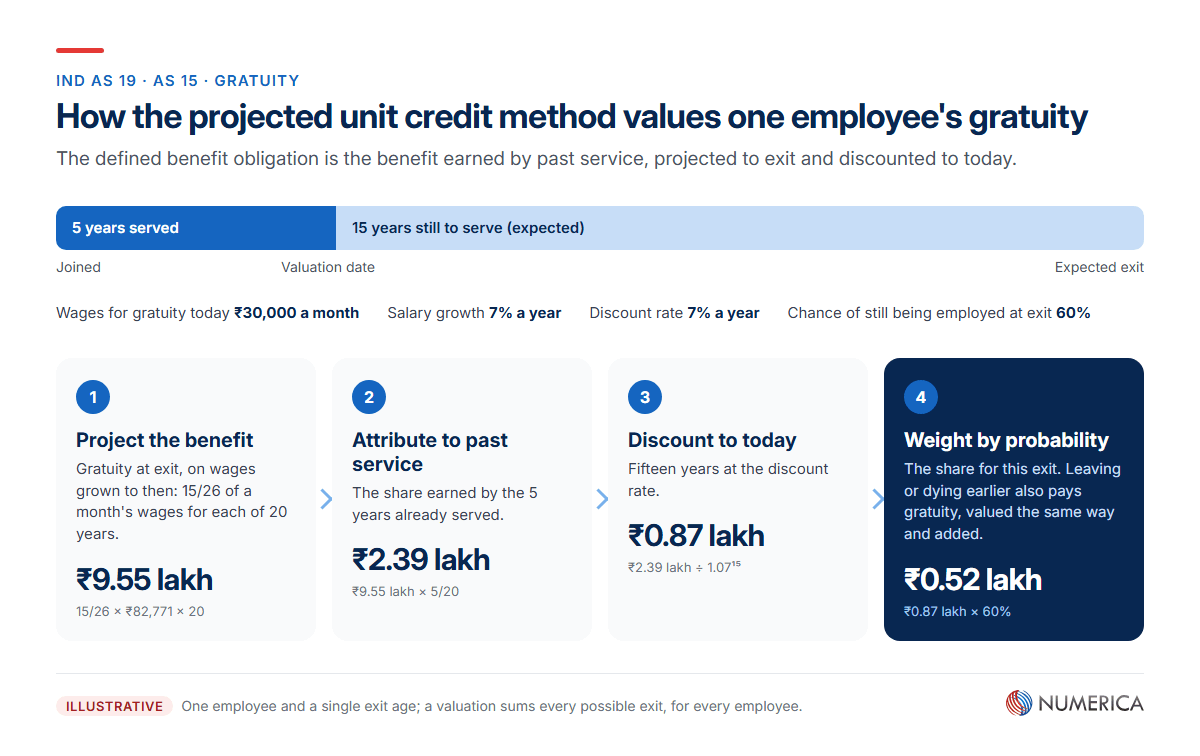
An actuarial valuation estimates what a company's promised employee benefits, such as gratuity, leave encashment or a pension, are worth today. An actuary projects the benefit each employee is expected to receive, allows for the chance of leaving, retirement or death, and discounts the part earned by service to date to a present value: the defined benefit obligation. The results, assumptions and disclosures are set out in an actuarial valuation report, which supports the figures in the company's accounts and is reviewed by its auditors.
Why do you need an actuarial valuation?
Usually for year-end accounts: AS 15 and Ind AS 19 require gratuity, pension and long-term leave encashment liabilities to be measured actuarially. An Indian subsidiary may also report to its overseas parent under IAS 19 or US GAAP (ASC 715). Other reasons are setting contributions to a gratuity fund or trust, pricing benefits in a merger or acquisition, and settling them on a wind-up.
How is an actuarial valuation of gratuity calculated?
We project each employee's benefit under the plan's rules, using assumptions for salary growth, attrition and mortality. We attribute it to service, weight it by probability and discount it to a present value: the liability. The projected unit credit figure below shows the steps for gratuity. The report's disclosures differ between AS 15 and Ind AS 19. Pension reporting and leave accounting raise issues of their own.
How to set actuarial assumptions?
Assumptions are the reporting company's responsibility, not the actuary's: our governance framework sets out who owns what. The discount rate comes from government bond yields, and we publish Indian rupee discount rates. Salary escalation and attrition are your own best estimates. Mortality, leave availment and disability matter for some schemes.
Interpreting the results in an actuarial report
The process of actuarial valuation does not end with getting an actuarial report from an actuary. You need to understand the results, validate and challenge them. The auditors must carry out their own assessment of the actuarial report.
By far the most important part of an actuarial report is the exhibit related to ‘reconciliation of Defined Benefit Obligation’. This disclosure presents an analysis of movement of the DBO and is required under most accounting standards. This post explains how to interpret this disclosure in the context of an AS 15 report.
More frequently asked questions
We have compiled a series of posts summarising commonly asked questions on individual topics around actuarial valuation, based on our own experience with our clients. They can be found here:
About Numerica
Numerica is an actuarial consulting firm and employee benefits consultancy, founded in 2010. In India we value gratuity, leave, pension and other long-term benefits under Ind AS 19 and AS 15.
Year end coming up?
Tell us about your plans and when you need the report, and get an instant quote.*
*In most cases.