
Employee benefits · Saudi Arabia and the GCC
Actuarial valuation of end-of-service benefits in Saudi Arabia and the GCC
End-of-service benefit (EOSB) valuations under IAS 19 and IFRS for SMEs, for employers in KSA, the UAE and the wider GCC.
EOSB and other IAS 19 plans we value
- Saudi EOSBThe statutory award under the Saudi Labour Law: half a month's wage for each of the first five years, a full month for each year after.
- EOSB elsewhere in the GCCEnd-of-service gratuity under the labour laws of the UAE, Qatar, Kuwait, Oman and Bahrain, including service accrued before a move to a funded scheme, such as Bahrain's for expatriates from March 2024.
- Enhanced EOSB schemesCompany benefits above the statutory minimum, set by contract or policy.
- Compensated absencesAccumulated leave paid out on exit.
- Pension and deferred income plansCompany defined benefit pensions and deferred bonus arrangements.
- Post-employment medicalMedical cover that continues after employment ends.
What you get from an IAS 19 EOSB valuation
- An IAS 19 actuarial report with full disclosures, including the reconciliation of the defined benefit obligation, sensitivity analysis and maturity profile
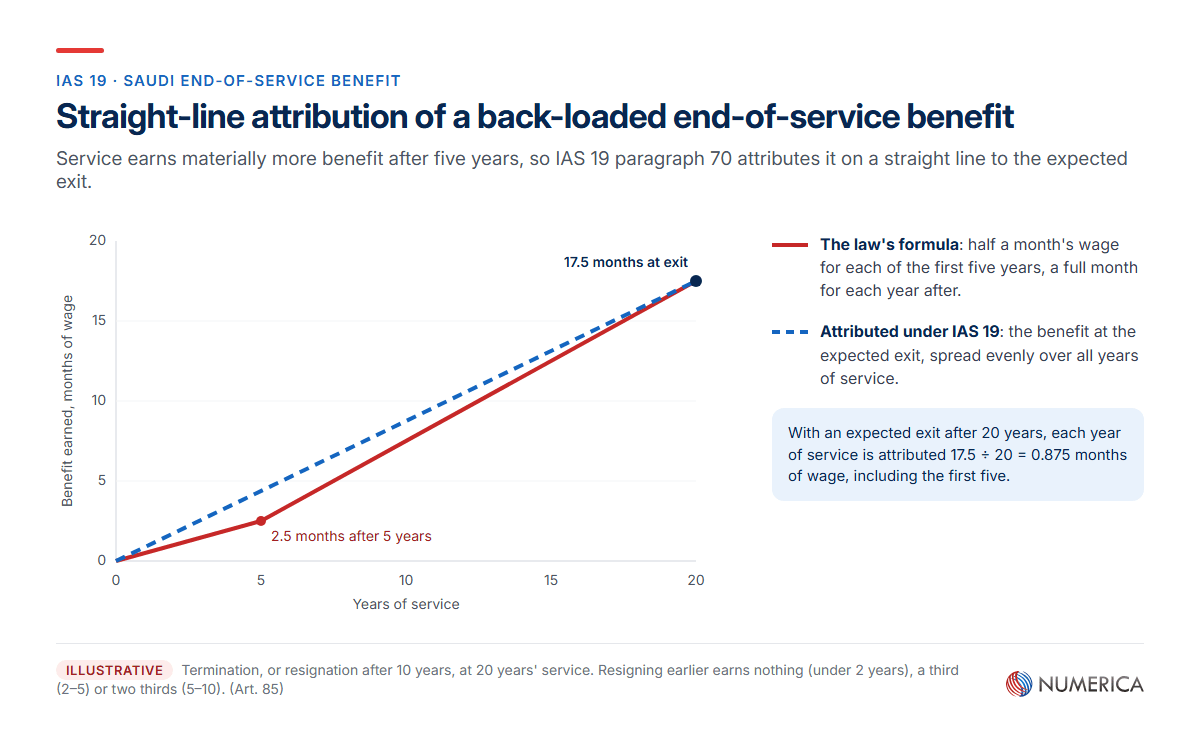
- Benefits attributed on a straight-line basis where EOSB accrues faster with longer service (IAS 19 paragraph 70)
- The defined benefit cost split between profit or loss (service cost and net interest) and other comprehensive income (remeasurements)
- An explanation of the movement in the liability, with actuarial gains and losses by source
- A discount rate supported by our published Saudi riyal discount curves
- Projected expense for the coming year, and answers to your auditors' queries
How an EOSB valuation works with us
- Request a quoteTell us your plans, countries and headcount and get an instant quote*.
- Send us your dataE-mail your employee data, or upload it to Numex, our secure client portal.
- Agree the assumptionsWe propose the discount rate, salary growth and withdrawal rates; you confirm them.
- Receive your reportYour report on the date agreed, then we answer your auditors' queries.
*In most cases.
Questions clients ask about EOSB valuation in Saudi Arabia
End-of-service benefits
What discount rate should we use for EOSB?
IAS 19 requires a rate based on yields on high-quality corporate bonds, or on government bonds where there is no deep market in such bonds, at the end of the reporting period, matching the currency and term of the benefits. We publish Saudi riyal discount curves every trading day, with a report each quarter. Your valuation report sets out the basis for your rate.
Does it matter whether employees resign or are terminated?
Yes. Under the Saudi Labour Law, an employee who resigns receives nothing before two years' service, a third of the award after two to five years, two-thirds after five to ten, and the full award after ten. We value resignation and termination exits separately, so your withdrawal data should distinguish them where it can.
Can you value our subsidiaries in other GCC countries?
Yes. Each country's end-of-service benefit follows its own labour law and currency. We value each plan on its own terms, keep assumptions consistent across the group where the economics allow, and report each entity separately with a summary for consolidation.
Understanding actuarial valuations
What is EOSB?
EOSB stands for end-of-service benefit: the amount due to an employee when service ends, usually paid by the employer as a lump sum under the country's labour law. In Saudi Arabia the full award is half a month's wage for each of the first five years and a full month for each year after. Under IAS 19 an employer-paid EOSB like this is a defined benefit plan, so the liability is measured by actuarial valuation. Where an employer instead pays into a funded scheme, as in Bahrain for expatriates since March 2024 or under the UAE's optional savings scheme, earlier service usually stays a defined benefit and later service depends on the scheme's terms.
What is IAS 19, and how do we comply with it?
IAS 19 is the IFRS standard on employee benefits. In Saudi Arabia, listed companies and other publicly accountable entities must apply it, through IFRS as endorsed there. Other companies use IFRS for SMEs as endorsed there, unless they choose full IFRS. Under IAS 19, end-of-service benefits (EOSB) are a defined benefit plan, so compliance means measuring the liability by actuarial valuation and making the required disclosures. Our article explains how IAS 19 applies to EOSB in Saudi Arabia.
How is an actuarial valuation done?
IAS 19 prescribes the projected unit credit method: project each employee's end-of-service benefit, attribute it to service, then discount it. Saudi EOSB accrues twice as fast after five years, so IAS 19 requires attribution on a straight line, not by the Labour Law formula. The figure below shows the difference. We explain when the straight-line approach applies and work through a Saudi example.
How to set actuarial assumptions?
They are your company's best estimates, and our governance framework sets out who decides what. IAS 19 bases the discount rate on high-quality corporate bonds or, with no deep market, government bonds in the same currency: see setting the discount rate for Saudi EOSB and our Saudi riyal discount curves. Salary escalation and attrition rest on your own experience and expectations, with resignations and terminations kept apart.
How do we interpret an actuarial valuation report?
Start with the reconciliation of the defined benefit obligation, which shows why the liability moved over the year. Remeasurements are the line to question: our article on actuarial gains and losses explains what drives them. Treat the report as something to challenge, as your auditors will. We list seven things to check when auditing an actuarial report, written for Ind AS 19 but useful under IAS 19.
More on EOSB and IAS 19
About Numerica
Numerica is an actuarial consulting firm, founded in 2010. For employers in Saudi Arabia and the GCC we value end-of-service benefits under IAS 19 and IFRS for SMEs.
Year end coming up?
Tell us about your plans and when you need the report, and get an instant quote.*
*In most cases.