
Employee benefits
Employee stock option valuation, design and IFRS 2 reporting
End-to-end services covering plan design, management, pricing and reporting under IFRS 2, Ind AS 102 and US GAAP.
Employee stock option valuation estimates the fair value of each award, and under IFRS 2 and Ind AS 102 that fair value drives the ESOP expense. IFRS 2, and its Indian counterpart Ind AS 102, require a company to measure share-based awards to employees at fair value and recognise the cost over the vesting period. Equity-settled awards are valued at grant date; cash-settled awards, such as most share appreciation rights, are remeasured at each reporting date until settled. A modification or repricing, or a cancellation that comes with a replacement award or a payment, needs a valuation at that date.
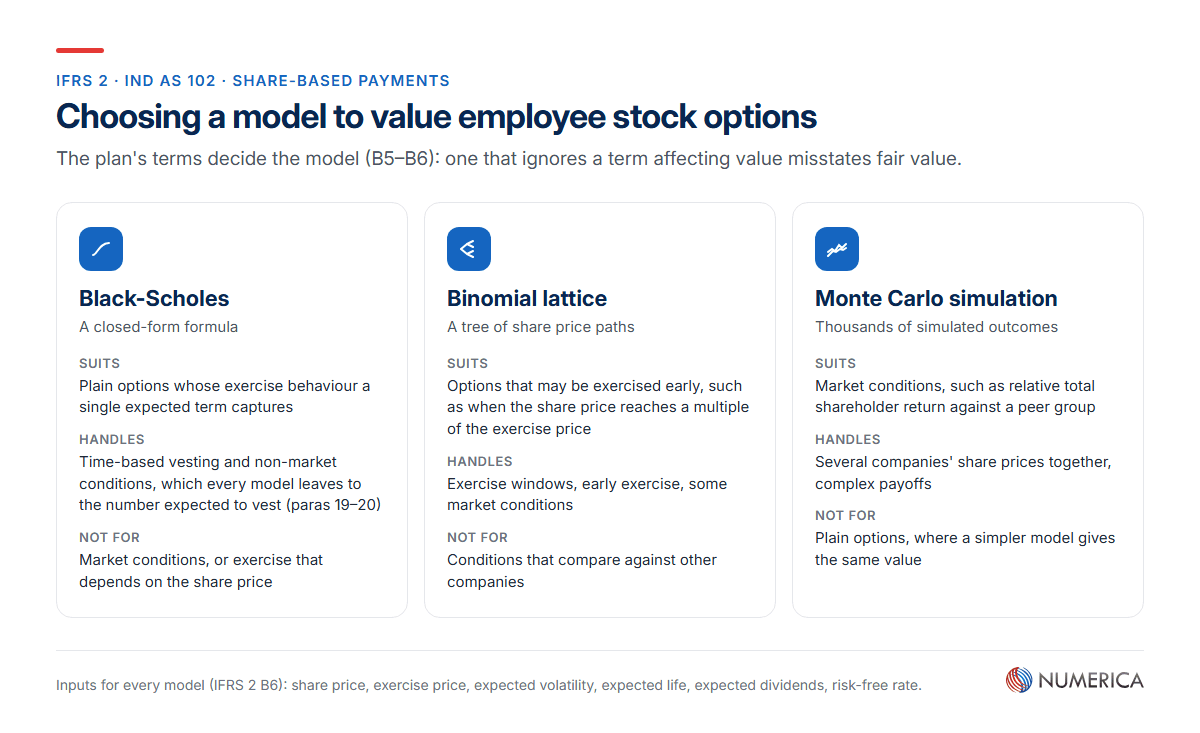
We choose the model the plan's terms call for (Black-Scholes, a binomial lattice or Monte Carlo simulation) and calibrate volatility, expected life, the risk-free rate and dividend yield to your data, with employee exits estimated for the number of awards expected to vest. Where a plan is still being drafted, we help shape its vesting, exercise and performance terms so the cost is understood before the first grant.
Share-based plans we design and value
- Employee stock options (ESOPs)Time-vested and performance-vested options, listed or unlisted companies.
- Restricted stock units (RSUs)And other conditional share awards.
- Share appreciation rights (SARs and ESARs)Cash- or equity-settled awards linked to share price growth.
- Performance sharesAwards with market conditions such as relative total shareholder return.
- Plan designNew schemes and changes to existing ones, costed before launch.
What you get from ESOP design and valuation
- Alternative plan designs, costed so you can see the expense each would produce before you grant
- A valuation report covering the disclosures IFRS 2 or Ind AS 102 requires
- Grant-date fair values for each tranche, with the method and inputs documented for audit
- An expense schedule over the vesting period, adjusted for expected leavers
- Market and non-market performance conditions treated as the standard requires
- Revaluations at each reporting date for cash-settled awards
- Extra calculations for interim or management accounts, on request
How an ESOP project works with us
- Request a quoteSend us the plan rules or your design ideas, with any grant summary; we quote on that scope.
- Send us your documentsE-mail your grant registers and plan documents, or upload them to Numex, our secure client portal.
- Review and modelWe review the scheme, choose the model and agree the inputs with you.
- Receive your reportFair values, expense schedule and disclosures, with support through the audit.
Questions clients ask about ESOP design and valuation
How do you value employee stock options?
The one the plan's terms require. Black-Scholes suits plain options whose exercise behaviour a single expected term captures; a binomial lattice handles early exercise; Monte Carlo simulation is usually used for market conditions such as relative total shareholder return. A model simpler than the terms warrant will not stand up to audit. We explain the choice in the report.
We are unlisted. How is volatility estimated?
Without a share price history, we estimate expected volatility from listed peers in the same sector, adjusted where size or leverage differ, and document how the peers were chosen. The share price at grant usually comes from a separate equity valuation, which we take as an input and reconcile to.
Can you help us design a new plan?
Yes. We cost alternative designs (vesting schedules, exercise prices, performance conditions, cash or equity settlement) so you can see the expense each would produce before you grant. The scheme must also meet local company, securities and tax law, including SEBI's regulations for listed companies in India; your legal advisers own that part.
Granting or changing awards?
Send us the plan rules or your design ideas, or arrange a call to talk it through.